
Smart Bras Move Toward Clinical Territory as Health Monitoring Drives Wearable Innovation
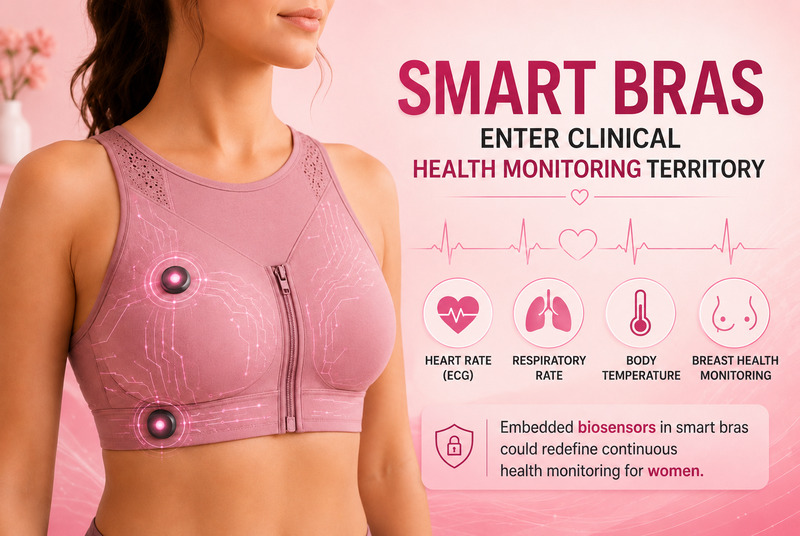
The next frontier in health wearables may not come in the form of a wristband or a ring. Researchers and textile engineers across the United States, Europe, and Asia are advancing a category of garments, smart bras embedded with biosensors, that could reshape how continuous health monitoring is delivered, particularly for women.
The development is no longer purely experimental. Academic institutions and medical device companies are now conducting structured trials using sensor-equipped bras to track cardiac rhythms, respiratory patterns, body temperature, and early markers of breast tissue changes. What was once a niche research topic is attracting serious institutional attention now.
What Is Driving the Shift?
The primary catalyst is a growing recognition that conventional wearables, particularly wrist-worn devices, perform inconsistently across different body types and skin tones.
A systematic review presented at the American College of Cardiology’s 71st Annual Scientific Session (2022) and subsequently published in PMC found that preliminary evidence suggests wearable devices may be less accurate at detecting heart rate in participants with darker skin tones, and researchers called for higher-quality evidence and larger, more diverse validation studies.
A separate PMC study further confirmed that inaccurate PPG heart rate measurements occur up to 15% more frequently in darker skin compared to lighter skin, likely because melanin absorbs more of the green light used by optical sensors
The bra, as a garment worn close to the chest wall for extended periods, offers structural advantages for sensor placement. Proximity to the heart and lungs makes it better suited for electrocardiogram (ECG) readings and respiratory rate tracking than peripheral limb devices.
Research groups in Japan, South Korea, and across Europe have published peer-reviewed work on integrating conductive textile electrodes into garments, including bra straps and chest bands, without compromising comfort or washability, with some textile electrodes remaining functional through up to 50 machine wash cycles.
Industry and Regulatory Landscape.
The commercial interest is real but cautious. A handful of companies, including Bloomer Tech in the United States and researchers affiliated with the European research consortium WEARPLEX, have moved into early clinical partnership phases.
Bloomer Tech’s smart bra, which targets cardiovascular data collection in women, has been cited in peer-reviewed commentary as one of the more clinically grounded products approaching the market.
Regulatory agencies have not yet established a dedicated framework for smart garments with diagnostic ambitions. The U.S. Food and Drug Administration classifies software and sensors differently depending on intended clinical use, and a smart bra used for wellness tracking faces a substantially different regulatory path than one intended to detect arrhythmias. This distinction matters significantly to manufacturers planning commercialization.
The European Medicines Agency and national health technology assessment bodies across the EU are monitoring the space, but formal guidance remains sparse. The gap between what the technology can currently do and what regulators are prepared to certify is a central tension the industry must navigate.
Data Privacy Remains an Open Question.
Intimate health data collected continuously by a garment raises concerns that differ from those of standard wearables. Biometric information about cardiac function, menstrual cycle patterns, and breast tissue temperature carries sensitive implications, particularly as data-sharing agreements between device manufacturers and third parties are rarely disclosed with adequate transparency.
Advocacy groups, including the Electronic Frontier Foundation, have consistently flagged the absence of comprehensive federal health data protections in the United States for data generated outside clinical settings. A smart bra sold as a consumer wellness product is not subject to HIPAA, meaning the data it generates is largely governed by the manufacturer’s own privacy policy.
Broader Implications.
If smart bras reach clinical validation and regulatory approval, they could represent a meaningful advance in women’s health monitoring, a field that researchers have long identified as underfunded relative to cardiovascular and metabolic research in men.
Early and continuous data capture could improve detection windows for conditions including atrial fibrillation and, in more speculative but active research, early breast tissue anomalies.
Related Posts
Women Continue to Demand Better Bra Fit, Comfort, and Size Inclusivity in 2026
Despite years of innovation in lingerie design, bra technology, and si

Why the Global Bra Market Is Growing: Key Trends Driving Demand in 2026 and Beyond
The global bra market is growing faster than ever. What was once seen

Gen Z Shopping Habits Reshaping the Global Intimate Apparel Market
The intimate apparel industry is undergoing a significant transformati

Social Media Reshapes Bra Shopping as Consumer Discovery Moves Beyond Traditional Retail
The way consumers shop for bras has undergone a significant transforma
The Most Common Bra Myths Debunked by Medical Experts
For years, advice about bras has been passed down through family tradi

The Workplace and the Invisible Expectations Around Bras
The modern workplace has become more flexible in many ways. Dress code
POST COMMENT